Table of Contents
- Understanding Your IP Complaints Plan of Action
- Step 1: Assess and Document the IP Complaint
- Amazon seller account IP Complaint Examples and What They Mean
- Step 2: Gather IP Complaint Appeal Evidence
- Step 3: Create Your IP Complaint Plan of Action Template
- Step 4: Submit Your IP Complaint Appeal
- Common Mistakes to Avoid
- Preventing Future IP Complaints
- Frequently Asked Questions
Last Updated: October 12, 2026
Understanding Your IP Complaints Plan of Action
An IP complaints plan of action is a formal written response submitted to a marketplace when your seller account or product listing receives an intellectual property violation notice. It’s your opportunity to address the complaint directly, explain your position, and demonstrate compliance with marketplace policies.
The stakes are high. A rejected plan of action often leads to permanent account suspension or listing removal. A strong one can get you reinstated within weeks.
The difference between a rejection and reinstatement typically comes down to how well you document your case and structure your response.
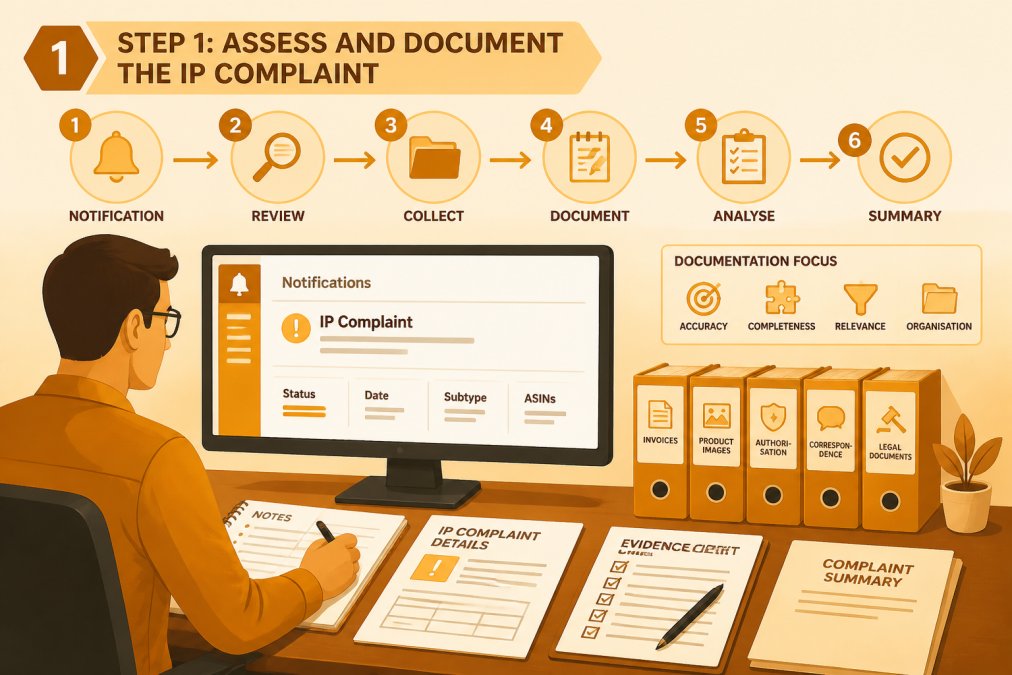
Step 1: Assess and Document the IP Complaint
Before you write a single word of your plan of action, you need to understand exactly what you’re being accused of. Read the complaint notice carefully. Identify the specific violation type and the claimant’s exact allegations.
Identifying the Complaint Type
IP complaints fall into several categories. Each requires a different response strategy.
Trademark claims allege that your product or listing uses a brand name, logo, or distinctive marking without permission.
Patent violations claim your product design, functionality, or manufacturing process infringes an existing patent. These are complex because they require technical proof.
Copyright infringement targets creative works: images, text, designs, or videos.
Counterfeit/authenticity complaints state you’re selling fake versions of a genuine brand. This is separate from trademark but often overlaps with it.
Understanding which category applies to your case shapes everything that follows.
Recording Key Details
Create a simple document. Write down:
- Date of complaint: When the notice arrived
- Marketplace: Which platform issued it
- Claimant name: Who filed the complaint
- Specific products affected: List every SKU or ASIN mentioned
- Exact allegation: Copy the complaint text word for word
- Your response deadline: When the marketplace expects your plan of action
This becomes your reference sheet. You’ll return to it repeatedly as you build your evidence and write your response.
Amazon seller account IP Complaint Examples and What They Mean
Real complaints vary widely. Here’s what common ones actually say and what they’re really asking.
Trademark Infringement Claims
A typical trademark complaint reads: “Your product listing uses the trademark ‘BrandName’ without authorisation. You must remove the product or provide proof of authorisation.”
What this actually means: The claimant holds a registered trademark for that brand name. They’re asserting you don’t have permission to use it. The marketplace needs proof that you either own the trademark, have a licence agreement, or are legitimately using the brand name in a way that doesn’t violate the trademark.
Your response must address one of these:
- You own the trademark (provide registration documentation)
- You have a written licence or distribution agreement (provide the signed agreement)
- You’re the authorised seller for that brand (provide correspondence from the brand confirming this)
- You’re reselling a genuine product under the brand’s own name (provide purchase invoices from authorised distributors)
Without one of these, the complaint stands.
Patent and Copyright Violations
A patent complaint might say: “Your product infringes patent number [X]. You must cease sales immediately.”
This is harder to defend because you need to prove either that your product doesn’t actually infringe the patent or that the patent itself is invalid.
A copyright complaint is more straightforward: “Your listing uses images/text that infringe our copyright. Remove the content immediately.”
Here, your defence is simple: remove the infringing content (images, text, video) and replace it with original material or material you have rights to use. Then submit a plan of action showing what you’ve changed.
Step 2: Gather IP Complaint Appeal Evidence
Evidence is everything. The marketplace doesn’t take your word for anything. It needs documentation.
Documentation You Must Collect
Start gathering these materials immediately:
- Proof of ownership: Trademark registrations, patent certificates, copyright registrations in your name
- Supplier documentation: Invoices from authorised distributors, wholesale purchase orders, import documents
- Licence agreements: Any written permission from the brand or IP holder
- Correspondence: Emails from the brand confirming you’re authorised to sell
- Product sourcing records: Where you obtained the product, when, and from whom
- Original content: Proof you created images, descriptions, or designs yourself (original files, design software records, creation dates)
- Business registration: Company documents showing your legal entity and business address
Gather everything, even if it seems marginal. You’re building a complete picture of legitimacy.
Building Your Evidence File
Organise your evidence into a single, clear document or folder. Label each piece clearly. Number them: Evidence 1, Evidence 2, and so on.
In your plan of action, you’ll reference these by number. “As shown in Evidence 3, we have a distribution agreement dated [date] from [Brand Name].”
The marketplace reviewer will look at what you reference and check it. If you say Evidence 3 proves something but it doesn’t, you lose credibility immediately.
Step 3: Create Your IP Complaint Plan of Action Template
Your plan of action is a formal letter. It follows a specific structure. Get this wrong and the marketplace dismisses it without reading the content.
Essential Components of Your Template
Every plan of action must contain:
- Clear statement of the problem: Restate the complaint in your own words, showing you understand it
- Your response to the allegation: Address it directly, deny it, explain it, or correct it
- Evidence: Reference the documentation you’ve submitted
- Corrective actions: What you’ve done or will do to prevent this happening again
- Commitment to compliance: A statement that you understand marketplace policies and will follow them
Structuring Your Written Response
Start with a professional header:
“Plan of Action Response to [Complaint Type] Notice”
Then open with acknowledgement:
“We received your notice dated [date] regarding [product name/ASIN]. We understand you allege [restate the claim]. We take this matter seriously and provide the following response.”
Never sound defensive or angry. Sound professional and cooperative.
Next, address the allegation directly. If it’s a trademark claim:
“We are the authorised reseller of [Brand Name] products in [region]. As shown in Evidence 1 (Distribution Agreement dated [date]), we have written authorisation from [Brand Name] to sell their products on seller account. We have never claimed to own the trademark. Our listings accurately describe the products as [Brand Name] goods.”
If it’s a copyright claim:
“We have removed the infringing image from listing [ASIN] effective [date]. The image has been replaced with an original photograph taken by our team. All future listings will use only original content or content we have explicit rights to use.”
Then explain your corrective actions:
“Going forward, we will:
- Review all product listings for compliance with trademark and copyright policies
- Ensure all product images are original or properly licensed
- Maintain records of all supplier authorisation agreements
- Train our team on IP policy requirements”
Close with a commitment statement:
“We are committed to full compliance with the policies. We appreciate the opportunity to address this matter and look forward to reinstatement.”
The entire response should be 300-500 words. Longer isn’t better. Clarity is.
Step 4: Submit Your IP Complaint Appeal
Once your plan of action is written and evidence is organised, you’re ready to submit.
Filing Your Appeal Correctly
Log into your seller account. Navigate to the suspension notice. Look for the option to “Appeal” or “Submit Plan of Action.”
Follow the marketplace’s submission process exactly. Upload your plan of action document. Attach your evidence files in the order you’ve referenced them.
Double-check everything before hitting submit:
- Is your plan of action in the correct format (PDF or Word)?
- Are all evidence files named clearly?
- Did you reference evidence correctly in your text?
- Is there a typo or grammatical error that makes you look careless?
Mistakes at this stage cost you. A misspelled brand name or a broken file upload can result in rejection.
What to Expect After Submission
Most marketplaces acknowledge receipt within 24 hours. Then you wait. Response times vary.
Response times vary. During this time, your account remains suspended.
The marketplace will either approve your plan of action, request more information, or reject it.
If they request more information, respond immediately with what they’ve asked for. Delays suggest you’re not serious about compliance.
If they reject it, you typically get one more chance to resubmit a revised plan of action. Make significant changes. If the first one didn’t work, the second needs to address what was missing.
Common Mistakes to Avoid
Most rejected plans of action fail for the same reasons.
Missing evidence. If you reference an agreement, attach it. If you don’t attach it, your claim is worthless.
Defensive tone. Don’t argue that the marketplace is wrong or the claimant is lying. Address the allegation factually and move forward.
Incomplete corrective actions. Don’t just say you’ll fix the problem. Explain specifically how. What processes will change? Who will oversee them?
Ignoring the deadline. Submit your plan of action before the marketplace’s deadline. Late submissions are often rejected without review.
Generic templates. Don’t use a cookie-cutter response. Customise it to your specific situation.
Preventing Future IP Complaints
Once your account is reinstated, prevent this from happening again.
Audit your listings regularly. Check product titles, descriptions, and images.
Document everything. Keep supplier invoices, distribution agreements, and correspondence.
Source from authorised distributors. Buy from official wholesalers or distributors, not grey-market resellers. Keep the invoices.
Create original content. Use original product images and descriptions.
Monitor your competitors. If you see someone selling counterfeit versions of your products, report it.
Understand marketplace policies. Read the IP policy section of every platform you sell on. Policies change.
The Appeal Guru helps sellers implement these practices and respond to IP complaints when they do occur.
Frequently Asked Questions
What should I include in my IP complaints plan of action to maximise reinstatement chances?
Your IP complaints plan of action must include a clear acknowledgement of the violation, detailed evidence of authorisation or legitimate ownership, corrective measures you’ve implemented, and proof of preventative steps. Address the specific complaint directly, provide invoices or licensing agreements where applicable, and explain how you’ve changed your processes. Seller Account reviewers assess both your understanding of the violation and your commitment to compliance—a thorough, honest response significantly improves reinstatement likelihood.
What evidence do I need for an Seller Account IP complaint appeal?
Gather supplier invoices, purchase orders, manufacturing agreements, trademark registrations, patent documentation, and licensing agreements relevant to your products. Include communications with your supplier confirming product authenticity, quality control documentation, and any third-party authentication certificates. If you’re the brand owner, provide proof of ownership such as trademark certificates or business registration. Organise these chronologically and label each document clearly so Seller Account review team can quickly verify your legitimacy and authorisation to sell.
How long does AMZ typically take to review an IP complaint appeal?
Seller Account review timeline varies depending on case complexity and current review volume. Some cases resolve faster if your evidence is comprehensive and compelling; others may take longer if additional investigation is needed. During this period, maintain account compliance and don’t list similar products. Patience is essential, but staying proactive with documentation strengthens your position.
Can I appeal an Seller Account IP complaint without an invoice from my supplier?
Invoices are highly valuable but not always essential if you can demonstrate legitimate authorisation through other means. Alternative evidence includes manufacturing agreements, licensing contracts, trademark certificates proving you own the brand, distributor authorisation letters, or formal letters from the brand owner granting you resale rights. However, missing supplier invoices weakens your appeal—they’re the most straightforward proof of legitimate sourcing. If you lack invoices, gather every alternative document you have and explain clearly why invoices aren’t available, ensuring your appeal remains credible and thorough.
Facing an IP complaint feels like the end. It’s not. A well-crafted plan of action backed by solid evidence gets sellers reinstated regularly. The marketplace wants to work with sellers who take compliance seriously. Show them you do, and you’ll get your account back.